
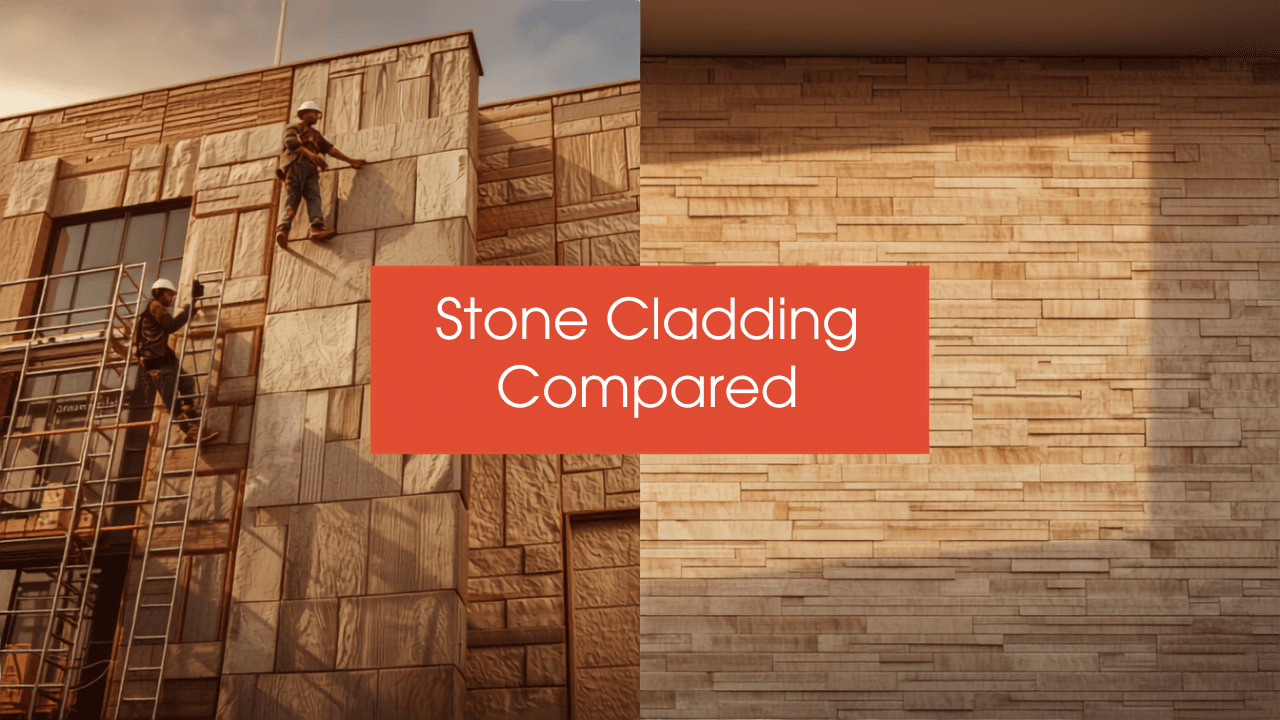
Stone cladding is one of the most requested finishes in UAE construction — villas, hotel lobbies, restaurants, commercial towers. The look of natural stone communicates quality in a way that nothing else does.
But traditional stone cladding comes with real challenges: it’s heavy, expensive, slow to install, and limits what you can do with curved or irregular surfaces. Flexible stone solves most of these problems — but it’s not the right choice for every situation.
This comparison breaks down exactly where each material wins, so you can make the right call for your project.
The Weight Problem
This is the single biggest difference and the one that drives most of the other advantages.
Traditional stone cladding — marble, granite, limestone — weighs between 25 and 50 kg per square metre depending on thickness (typically 10-30mm). For a 50m² lobby wall, that’s 1,250 to 2,500 kg of stone hanging on your wall structure.
Flexible stone weighs 1.5-3 kg per square metre at 1-2.5mm thickness. The same 50m² lobby wall: 75-150 kg total.
In the UAE, this matters enormously. Many projects involve:
- High-rise apartments where load calculations are tight
- Retrofits and renovations of existing buildings not designed for heavy stone
- Ceilings and overhead surfaces where traditional stone is impractical or dangerous
- Lightweight partition walls (drywall/gypsum) that can’t support heavy stone
Flexible stone opens all of these applications. Traditional stone requires structural assessment and often reinforcement.
Installation: Time and Cost
Traditional stone installation requires skilled stone masons, heavy lifting, mechanical fixings or thick-bed adhesive, precise cutting with diamond tools, and careful handling to avoid breakage. A professional team can install approximately 5-8 m² per day.
Flexible stone installation requires standard adhesive, a utility knife or scissors, and basic surface preparation. An experienced installer can cover 15-20 m² per day.
For a 200m² commercial project, that’s roughly:
| Factor | Traditional Stone | Flexible Stone |
|---|---|---|
| Installation days | 25-40 days | 10-13 days |
| Labour skill level | Specialist stone masons | Standard tile installers |
| Equipment needed | Diamond cutters, lifting gear | Knife, roller, adhesive |
| Waste factor | 10-15% (breakage, cutting) | 3-5% (trimming only) |
In a market where labour and project time directly impact cost, the installation advantage alone makes flexible stone worth considering.
Where Traditional Stone Still Wins
Flexible stone is not a universal replacement. Traditional stone is the better choice when:
Floor applications. Flexible stone (see our complete guide) is a wall and surface material. For floors, you still need the thickness and structural integrity of traditional stone tiles or slabs. Marble floor tiles, granite flooring — these require solid stone.
Countertops and heavy-use surfaces. Kitchen countertops, bathroom vanities with heavy use — these benefit from the thickness and impact resistance of solid stone or engineered stone.
Ultra-premium prestige projects. Some clients — particularly in ultra-luxury hospitality — specifically want the depth, mass, and perceived value of thick natural stone. A 30mm marble slab has a visual depth and heft that a 2mm flexible stone sheet doesn’t replicate.
Restoration and heritage projects. When matching existing stonework or meeting heritage specifications, traditional stone is typically required.
Where Flexible Stone Wins Clearly
Curved surfaces. Columns, arches, rounded walls, undulating feature surfaces — flexible stone bends naturally. Traditional stone requires expensive custom-cut segments that never quite match the curve perfectly.
Lightweight structures. Drywall partitions, steel-frame buildings, ceiling applications, furniture surfaces — anywhere that can’t handle 25-50 kg/m².
Large-area wall cladding. For lobby walls, entire villa exteriors, commercial interiors — the cost and time savings compound significantly at scale.
Renovation and retrofit. Existing buildings where you want a stone upgrade without structural modifications.
Tight timelines. When the project schedule doesn’t allow for 40 days of stone installation.
Cost Comparison
Exact pricing depends on the stone type, project size, and complexity. But directionally:
| Cost Element | Traditional Stone | Flexible Stone |
|---|---|---|
| Material cost | Higher | Lower |
| Installation labour | Higher (specialist) | Lower (standard) |
| Structural reinforcement | Often required | Rarely required |
| Waste/breakage | 10-15% | 3-5% |
| Project timeline | Longer | Shorter |
| Total project cost | Higher | Lower |
For a typical 100m² interior wall cladding project in the UAE, flexible stone can deliver savings of 30-50% compared to traditional stone — while achieving a visually similar result.
Durability in UAE Climate
Both materials perform well in the UAE climate, but through different mechanisms:
Traditional stone is inherently durable — it’s solid rock. However, it can suffer from thermal expansion cracking at joints, moisture penetration in porous stones (limestone, sandstone), and salt crystallisation damage near coastal areas.
Flexible stone is UV-stable, heat-resistant, and its thin profile means virtually no thermal expansion issues. The backing material is engineered for moisture resistance. However, it has less impact resistance than solid stone — a hard blow can chip the thin stone surface.
For outdoor facades in the UAE, both work. For high-traffic areas where physical impact is a concern, traditional stone’s thickness provides more protection.
Making the Decision
Ask these questions about your project:
- Is it a wall/surface application or a floor? Floor = traditional stone. Wall/surface = both are options.
- Are there curved or irregular surfaces? Yes = flexible stone.
- What’s the structural capacity? Limited = flexible stone. Full capacity = both options.
- What’s the timeline? Tight = flexible stone advantage.
- What’s the budget? Budget-conscious = flexible stone delivers stone aesthetics at lower cost.
- Is it ultra-luxury specification? If clients require thick slab stone = traditional. If they want natural stone aesthetics = flexible stone delivers.
Related Articles
- What is Flexible Stone? The Complete Guide for UAE Projects
- 10 Ways to Use Flexible Stone in UAE Interiors and Exteriors
- Best Flooring for UAE Climate: What Actually Survives Heat, Humidity, and Heavy Use
- Browse Our Full Product Gallery
See Both Options at NOVA Select
Our showroom in Ajman — browse our product gallery online or get in touch carries both flexible stone sheets and traditional marble tiles. We can help you compare materials side by side and recommend the right solution for your specific project — whether it’s a villa renovation, commercial fit-out, or new construction.
Contact us for a free consultation or visit our showroom in Al Jerf Industrial 1, Ajman.
Ready to Get Started?
Visit our showroom in Ajman or request a free consultation and samples.
Request a Quote